Gypsum dispersant

01 Overview

Adding a dispersing agent to the gypsum slurry used for plasterboard can improve its flow properties during application. To reduce the energy consumed during the drying of plasterboard, it is desirable to minimize the amount of water added during production; however, reducing the water content impairs the flowability of the gypsum mixture and makes it difficult to mix, necessitating the use of a water-reducing agent or dispersing agent.

High-Performance Gypsum Dispersants for Water Reduction and Slurry Flow Improvement

SIDLEYCHEM supplies high-performance gypsum dispersants based on polycarboxylate ether (PCE) technology, specifically selected for plasterboard manufacturing, gypsum block production, and other gypsum-based building materials.

Gypsum dispersants, also known as gypsum water-reducing agents or PCE superplasticizers, improve the dispersion of gypsum particles and enhance slurry fluidity. By reducing the amount of water required to achieve the target flowability, these additives help manufacturers optimize processing conditions, reduce excess moisture, and improve production efficiency.

In industrial gypsum board manufacturing, a significant portion of the mixing water must be removed during drying. Excessive water consumption increases drying requirements and can negatively affect production economics.

SIDLEYCHEM gypsum dispersants are developed to address these challenges by providing efficient water reduction, improved slurry handling, and application-specific performance. Our product portfolio includes liquid and powder PCE dispersants for different gypsum manufacturing processes.
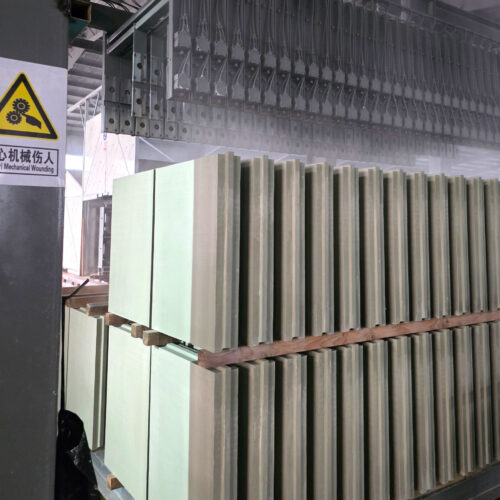
02 Dispersant For Plasterboard

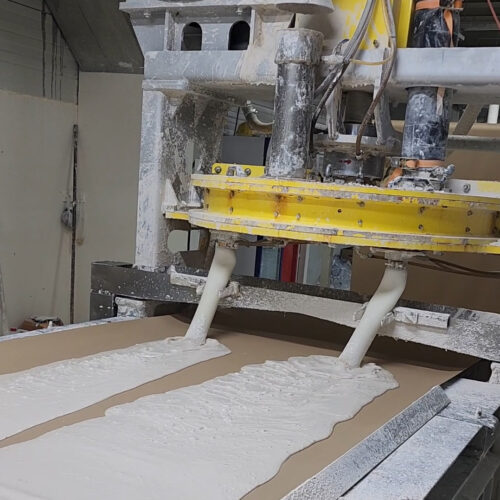
In gypsum board production, dispersants help improve the flow and dispersion of gypsum slurry. PCE dispersants specially designed for gypsum board applications can help reduce the mixing water required to achieve the target slurry flow and support efficient processing. This product has no impact on the setting time of gypsum and is air-bubble friendly. It is highly effective even at low dosage levels, offering excellent water-reduction efficiency; this allows for the use of less water, thereby reducing energy consumption and lowering costs.

PRODUCT NAME PRODUCT TYPE DESCRIPTION Benchmarking product DESCRIPTION
Water-Reducer PCE-1041L Liquid Melflux PCE 541 F.F. Foam friendly Superplasticizers, high water reduction, For use with plasterboard

Key Features

  • Improved flowability: Helps gypsum slurry flow and spread more smoothly during production and forming.
  • Reduced water demand: Can help lower mixing water while maintaining the required slurry flow.
  • Bubble-friendly: does not suppress foam; has no impact on foaming agents..
  • Lowers energy: Reduces water consumption, lowers energy usage for drying, and cuts costs..

03 Dispersant For Gypsum Blocks

Gypsum block production requires slurry with suitable flowability and casting performance, while maintaining appropriate setting time and block strength. PCE dispersants specially designed for gypsum block applications help disperse gypsum particles, improve slurry flow and reduce the mixing water required to achieve the target workability. PCE based superplasticizers are used in gypsum block and other gypsum systems; performance depends on the gypsum raw material and formulation.

Water-Reducer PCE-104L(50%) Liquid / SuperPlasticizers admixtures, For use with Gypsum blocks
PCE-803P Powder / SuperPlasticizers admixtures, For use with Gypsum blocks

Key Features

  • Improved slurry flow: Helps the slurry pour and fill molds more smoothly.
  • Reduced water demand: Can help lower mixing water while maintaining the flow required for casting.
  • High water-reduction efficiency: low dosage, and reduced costs

04 Questions & Answers

  1. 1
    What additives are commonly used in gypsum board production?

    Common additives include dispersants (water reducers), foaming agents, modified starch, retarders, accelerators, water repellents and, where required, defoamers. They help control slurry flow, core density, paper-to-core bonding, setting and water resistance. The additive package depends on the board type and production process.

  2. 2
    What is the main function of a dispersant in gypsum board production?

    A dispersant helps improve gypsum slurry flow and particle dispersion. It may also reduce water demand while maintaining the required flow. Lower excess water can help reduce the drying load. Results depend on the gypsum source, dispersant type and production conditions.

  3. 3
    Can PCE dispersants be used in gypsum board production?

    Yes. Polycarboxylate ether (PCE) dispersants are used in gypsum board production. A product designed for gypsum systems should be selected; a standard concrete PCE may not be a direct substitute. Evaluation should include slurry flow, water demand, setting time, foaming behavior and board performance.

  4. 4
    Why is a dispersant used in gypsum block production?

    A dispersant helps disperse gypsum particles and improve slurry flow and casting performance. With a suitable product, water demand can be adjusted while maintaining the flow needed to fill the molds. Results depend on the gypsum source, formulation and production conditions.

  5. 5
    Is PCE dispersant suitable for gypsum blocks?

    Potentially. A suitable dispersant can improve slurry flow and may allow lower water content while maintaining the required casting performance. The achievable reduction must be tested with the actual gypsum; it cannot be predicted from the additive type alone.

  6. 6
    Does a higher dosage always give better flow?

    No. Excessive dosage may cause bleeding, segregation or delayed setting, and may affect casting and block strength. Begin with a low dosage and increase it gradually to find a range that provides suitable flow while maintaining normal setting and demolding.

  7. 7
    How should dispersant trials for gypsum blocks be conducted?

    Keep the gypsum, mixing water and mixing conditions constant, then compare several dispersant dosages. Record slurry flow, workable time, setting time, mold filling, demolding, drying behavior and block strength. Confirm the final dosage through production trials.