Powdered Cellulose

01 Overview

Powdered cellulose is a powdered additive for chemical building materials products, manufactured by processing wood pulp. It is a naturally occurring fiber insoluble in water, exhibiting excellent flexible strength, dispersibility, and chemical inertness. Powdered cellulose is environment friendly products, gained from cellulose raw materials.

SIDLEYCHEM Powdered Cellulose is a natural, water-insoluble cellulose fiber additive derived from processed wood pulp, specially developed to improve the performance of cement-based and gypsum-based dry-mix mortars. As a functional additive for construction materials, powdered cellulose can also help reduce the risk of shrinkage-related cracking and improve mortar stability during application and drying.

Synonyms For: Cellulose Fibre, Powdered cellulose, Natural Cellulose Fibers, pulvercellulose and wood fibres
Item W500 G500
Cellulose Content,% 98% 98%
Bulk Density,g/cm3 1.1-1.3 1.1-1.3
Average Length(mm) 0.40-0.60 0.40-0.60
Moisture% ≤5.0 ≤5.0
Appearance and Color White powder Gray powder
Dispersity 99.8% 99.8%

Powdered cellulose is a fibrous additive that extracted from wood pulp and through chopped, neutralized, bleached, crushed and sieved into finished products with different lengths and thicknesses to suit the needs of different materials and formulations. It can be mixed with powder materials such as cement, gypsum and lime to improve the resistance of cracking, water retention and resistance of shrinkage.

Powdered cellulose and hydroxypropyl methylcellulose are two different products. Powdered cellulose is a water-insoluble natural fiber, which is essentially different from hydroxypropyl methylcellulose. Although certain functions of wood fiber, such as thickening and water retention are similar to that of  hydroxypropyl methylcellulose, their thickening and water retention effects are much lower than those of hydroxypropyl methylcellulose and cannot be used as a thickener and water retention agent individually. The biggest role of Lignocellulose is the flexibility of the material itself, and its anti-hanging property.

Powdered cellulose has been widely used in dry mortar, such as the production of tile adhesive, crack-sealer, dry powder coating, interior and exterior wall putty, interface agent, thermal mortar, anti-cracking mortar, waterproof mortar and plastering anhydrite.

Because Powdered cellulose has good property of flexibility and dispersibility, adding appropriate amount of wood fiber with different length into dry mortar product can enhance the resistance of shrinkage and crack to improve the thixotropy and sag resistance of the product and prolong the opening time and play a certain thickening effect.

Powdered cellulose 1:7.5 water
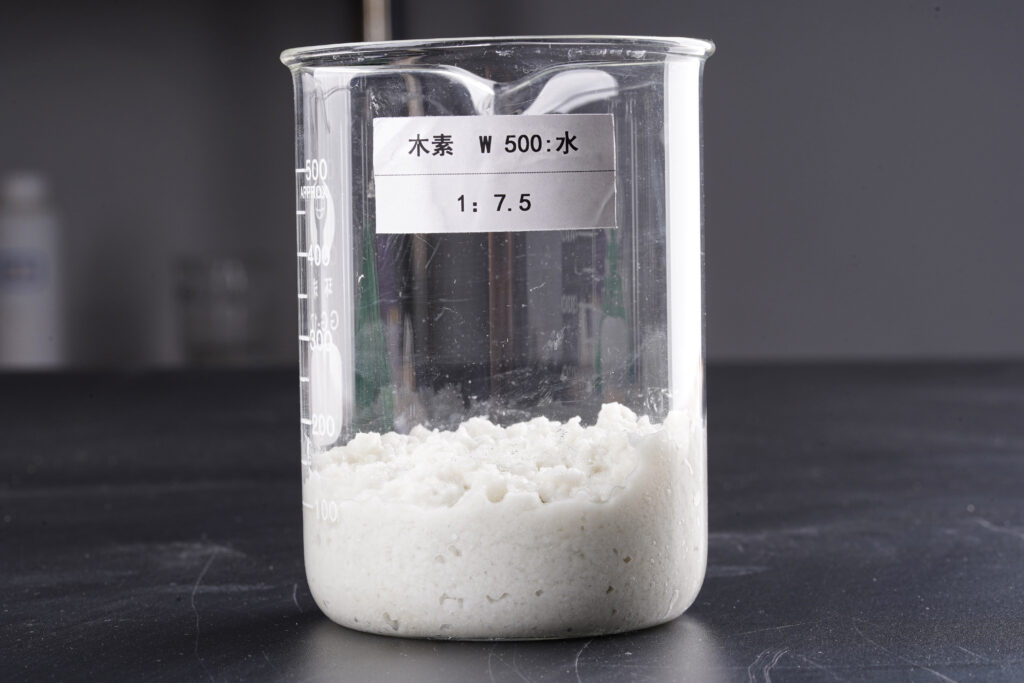
Water Absorption Capacity of Powdered Cellulose

02 Applications of Powdered Cellulose in Dry-Mix Mortar

  • Powdered Cellulose for Tile Adhesives

Powdered cellulose is used as a functional additive in cementitious tile adhesive formulations to improve mortar cohesion, thixotropy, and sag resistance. Its fibrous structure contributes to the internal stability of fresh mortar, helping the adhesive maintain its shape during vertical tile installation. Combined with suitable cellulose ethers and redispersible polymer powders, powdered cellulose can help optimize application consistency and slip resistance.

  • Powdered Cellulose for Cement Render and Plaster

Powdered cellulose is widely applicable to cement-based rendering mortars requiring good workability, structural stability, and sag resistance. Its reinforcing fiber network helps maintain the shape of fresh mortar after application and can contribute to reducing shrinkage-related cracking. It is particularly useful for vertical rendering and selected thick-layer plaster systems.

  • Powdered Cellulose for Wall Putty and Skim Coat

Selected powdered cellulose grades can improve the cohesion and rheological properties of cement-based wall putties and skim coats. They can help reduce the risk of shrinkage-related surface cracks while maintaining good application consistency. The fiber length and dosage should be optimized to preserve the required surface smoothness and finishing quality.

  • Powdered Cellulose for ETICS and Insulation Mortar

In external thermal insulation systems (ETICS), powdered cellulose can be incorporated into cementitious base coats and reinforcement mortars. It helps improve mortar cohesion, dimensional stability, and anti-sagging performance. Powdered cellulose is typically used alongside cellulose ethers and polymer binders to achieve the necessary balance of application performance and mechanical properties.

03 Questions & Answers

  1. 1
    What is powdered cellulose?

    Powdered fibre is an organic fibre derived from natural timber through chemical processing. It typically exhibits a cotton-like appearance, appearing white or greyish-white in colour. This fibre finds extensive applications across multiple sectors, such as road surfacing, concrete reinforcement, and fire-retardant coatings. Owing to its unique physical and chemical properties, Powdered Cellulose has become a vital component in modern building materials.

  2. 2
    How Does Powdered Cellulose Work in Mortar?

    The primary mechanism of powdered cellulose is associated with its fibrous structure and ability to form a three-dimensional network throughout the mortar.

    • During Mixing: Powdered cellulose fibers disperse throughout the dry-mix mortar and interact physically with water, binders, and mineral fillers.
    • During Application: The fiber network modifies the rheological behavior of the mortar, contributing to cohesion, thixotropy, and application consistency.
    • After Application: The network helps maintain mortar stability and resistance to sagging, especially on vertical surfaces.
    • During Drying: Uniformly dispersed fibers can redistribute certain local stresses and contribute to reducing shrinkage-related cracking.

    The actual performance depends on fiber length, addition rate, mixing conditions, binder composition, and other formulation additives.

  3. 3
    Powdered Cellulose vs. HPMC and MHEC

    Powdered cellulose and cellulose ethers such as HPMC and MHEC are commonly used in dry-mix mortars, but they have different functions.

    Property Powdered Cellulose HPMC / MHEC
    Water Solubility Insoluble Water-soluble
    Primary Function Fiber network reinforcement and rheology modification Water retention and thickening
    Sag Resistance Improves structural stability Controls viscosity and rheology
    Crack Control Helps control selected shrinkage-related cracks Indirect effect through moisture and rheology control
    Water Retention Secondary physical effect Main functional property
    Typical Application Supplementary functional additive Primary water-retaining and thickening additive

    Powdered cellulose cannot directly replace HPMC or MHEC in formulations that require high water retention.

    However, combining powdered cellulose with suitable cellulose ethers can help manufacturers optimize workability, sag resistance, water retention, and crack control.

  4. 4
    Production Methods for Powdered Cellulose

    The production process for Powdered Cellulose involves several key steps. Firstly, high-quality timber such as pine or birch is selected as raw material. The wood is then cut and pulverised into wood chips. Chemical treatment, typically using alkaline solutions, removes lignin and other impurities from the wood.Finally, the treated wood pulp undergoes fibrillation to yield the final cellulose fibres. Precise control of conditions throughout this process is essential to ensure fibre quality and performance.
    Furthermore, during Powdered Cellulose production, subsequent treatments such as bleaching, drying, and shaping may be applied as required to meet diverse application needs. These processing steps can further enhance the fibre’s whiteness and purity while improving its physical and chemical properties.

  5. 5
    Can powdered cellulose improve tile adhesive sag resistance?

    Yes. Powdered cellulose can contribute to anti-sagging performance by improving the structural stability of fresh tile adhesive.

    Its effect should be evaluated together with cellulose ethers, polymers, and other rheology modifiers in the complete formulation.

  6. 6
    What is the difference between powdered cellulose and polypropylene fiber?

    Powdered cellulose is a natural, hydrophilic fiber mainly used for fresh mortar rheology modification, cohesion, and supplementary crack control.

    Polypropylene fiber is a synthetic fiber commonly used for crack control and reinforcement in concrete and selected mortar applications.

    The two materials perform different functions and should be selected according to the formulation requirements.

04 Product Video

06 Comments

Leave a Reply