
Low Demolding Strength in Precast Concrete: Causes & Fixes
Fast demolding is important in precast concrete production because mold turnover directly affects production efficiency.
A common problem is that the concrete looks normal after casting, but the required early strength is not reached at the planned demolding time.
The first reaction may be to increase the accelerator or early-strength admixture.
But low demolding strength does not always mean that the dosage is too low.
1. Check Concrete Temperature First

Early cement hydration is strongly affected by temperature.
If the same concrete performs well in summer but develops strength slowly in winter, the main problem may be curing temperature rather than the admixture.
Check:
- cement temperature;
- mixing-water temperature;
- fresh concrete temperature;
- mold temperature;
- curing temperature.
A relatively small temperature change can significantly affect early strength development.
Therefore, laboratory testing should reproduce actual plant conditions as closely as possible.
2. Has the Cement Changed?
Cement from different suppliers—or even different production batches—may show different early hydration behavior.Changes in:
- cement fineness;
- mineral composition;
- sulfate balance;
- supplementary cementitious materials;
can affect both setting and early strength. If the problem appears immediately after changing cement, test the old and new cement under the same conditions before changing the admixture system.
3. Check the Water-Binder Ratio
Extra water improves workability, but it may reduce early strength.
This often happens when operators add water because the concrete feels too stiff during production.
The slump may improve, but the planned demolding strength may not be reached.
When troubleshooting, compare:
- designed water dosage;
- actual water added;
- aggregate moisture;
- slump or flow;
- early compressive strength.
Do not evaluate the admixture before confirming the real water-binder ratio.
4. Early Strength and Setting Time Are Not the Same
A concrete that sets quickly does not automatically develop enough strength for safe demolding.
An early-strength admixture should be evaluated by actual strength development, not only by initial or final setting time.
SidleyChem’s strength-enhancing and set-accelerating products are designed to promote early strength development and are used in ready-mixed and precast concrete applications.
For precast production, it is more useful to test compressive strength at the actual planned demolding age—for example 6, 8, 10, or 12 hours—rather than looking only at 1-day strength.
5. Check the PCE System
 The polycarboxylate superplasticizer also affects the result.
If the PCE provides excellent workability but causes excessive retardation in the selected cement system, early strength development may be delayed.
Possible signs include:
- normal or high initial flow;
- long setting time;
- concrete remains soft for longer than expected;
- 1-day strength is acceptable but very early strength is low.
In this situation, simply increasing the early-strength additive may not be the best solution.
The PCE, cement, and accelerator should be evaluated as one system.
6. A Simple Troubleshooting Comparison
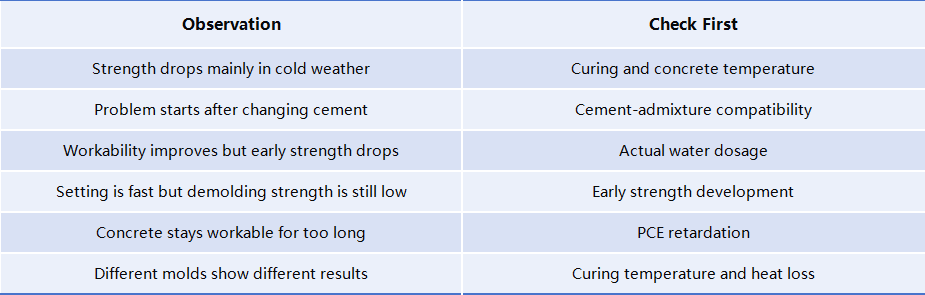
Prepare controlled samples and change only one variable at a time.
Compare the current formulation with:
- adjusted curing temperature;
- controlled water dosage;
- alternative PCE dosage;
- adjusted early-strength admixture.
For critical demolding decisions, in-place strength can also be evaluated using established maturity-based methods that relate concrete temperature history to strength development. ASTM C1074 specifically lists formwork removal as one application of this approach.
Conclusion
Low demolding strength in precast concrete should not automatically be solved by adding more accelerator.
The cause may come from:
- low curing temperature;
- cement variation;
- excessive water;
- PCE retardation;
- insufficient early-strength development;
- poor compatibility between admixtures.
The best approach is to control temperature and water first, then evaluate the cement, PCE, and early-strength admixture together.
For precast production, the real target is not simply faster setting—it is reliable strength at the required demolding time.




Concrete & Beton Tech+
Sticky Concrete with Normal Slump: Causes & Solutions
Concrete can have normal slump but still feel sticky and difficult to pump. Learn how fines, PCE, VMA, aggregate grading, and rheology affect pumpability… Continue reading
PCE Cement Compatibility: Why Performance Changes
PCE performance can change after switching cement. Learn why water reduction, slump retention, and setting behavior change and how to identify the cause… Continue reading
Why Does Concrete Strength Vary Between Batches?
Learn why concrete strength varies between batches and how to improve consistency through proper water control, raw materials, admixture dosing, mixing, and curing… Continue reading
The Role of Expanding Agents in Compensating Shrinkage of Mass Concrete Foundations
Cracking after mass concrete foundation pouring? Thermal shrinkage, drying shrinkage, and autogenous shrinkage combined are the culprits. … Continue reading
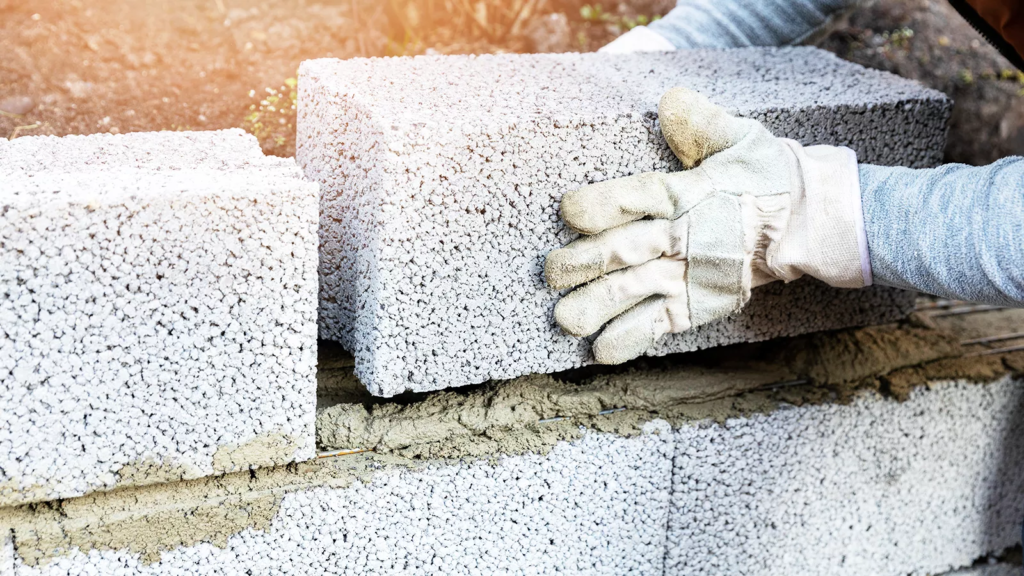
Lightweight Aggregate Concrete Lacking Viscosity?
Lightweight aggregate concrete segregation, aggregate floating, pump blockages? The root cause is insufficient viscosity. This article details four practical methods — viscosity modifier dosage (0.02%–0.03%), aggregate pre-wetting, mix optimization, and specialized admixtures — to solve workability problems once and for all… Continue reading
How Does Air-Entraining Agent Affect Concrete Strength?
Each 1% air content reduces concrete strength by 4%–6%. How to balance? This short article gives three practical methods: measure air content, lower w/c, and choose a stable-foam AEA. Direct and actionable… Continue reading
The Three Critical Windows for Concrete Curing
Same mix design, with and without proper curing – 28‑day strength can differ by a whole grade. This article explains hydration mechanisms, three critical curing windows, and practical steps to prevent strength loss and cracking… Continue reading
Which Admixtures Improve Concrete Durability?
Discover which concrete admixtures improve durability, including Polycarboxylate Superplasticizers, Air-Entraining Agents, Corrosion Inhibitors, Waterproofing Admixtures, and Concrete Fibers. Learn how to enhance strength, reduce permeability, and extend service life… Continue reading
How to Maintain Slump Retention During Long-Distance Transportation
Learn how to maintain concrete slump retention during long-distance transportation by optimizing mix design, selecting the right admixtures, and improving production practices… Continue reading
Why Does Concrete Bleeding Occur?
Learn why concrete bleeding occurs, what causes excessive bleeding, and how to reduce it using proper mix design, Polycarboxylate Superplasticizers (PCE), and Viscosity Modifying Agents (VMA)… Continue reading
