
CMC Paper Applications
Sodium Carboxymethyl Cellulose (CMC) is widely used in the paper industry because it plays a “customized” key role in meeting the specific requirements of different paper types. It enhances paper strength, improves formation uniformity and printability, while optimizing production efficiency and reducing costs. This article systematically reviews CMC applications in various paper grades and key technical considerations.
1. CMC Applications in Different Paper Types
1.1 Printing Paper
-
Coated Paper/Art Paper: As a coating thickener and stabilizer, it increases coating strength, improves adhesion and gloss, reduces printing dusting, and imparts excellent gloss and printability.
-
Offset Paper: Mainly used for surface sizing. Forms a strong film on the paper surface, solving linting and dusting issues during high-speed printing, while improving ink absorption uniformity for clear printing and vibrant colors.
1.2 Packaging Paperboard (Linerboard, etc.)
-
Enhances hydrogen bonding between fibers, significantly improving ring crush strength, burst strength, and stiffness, increasing box load-bearing capacity.
-
Improves wet strength, extending packaging service life.
-
Increases interlayer bonding, reducing defects like delamination and blistering.
1.3 Tissue Paper
-
Wet-End Strengthening Agent: Tissue paper is typically unsized, pursuing softness and water absorption. Adding very low doses of high-DS CMC can appropriately improve dry/wet strength without affecting softness, preventing holes during use.
1.4 Specialty and Functional Paper
-
Cigarette Paper: Regulates paper permeability for stable combustion; enhances stiffness and flexibility for cigarette processing, while preventing breakage during smoking.
-
Filter Paper: Enhances wet strength to prevent paper breakage when filtering liquids, ensuring smooth filtration process; affects fiber bonding to indirectly regulate permeability.
-
High-Precision Industrial Paper: Used as wet-end additive and surface treatment agent to enhance fiber bonding and durability; prevents dimensional changes in specialty papers like banknote paper due to humidity variations.
2. Key Parameters and Considerations for CMC Application
-
Viscosity Selection: High-DS, medium-high viscosity CMC suitable for surface sizing and coating for better water retention; medium-low viscosity CMC suitable for wet-end addition.
-
pH Compatibility: pH during CMC addition should be controlled within appropriate ranges for different applications.
-
Charge Balance: CMC is anionic; attention should be paid to system charge balance to avoid flocculation or reduced effectiveness.

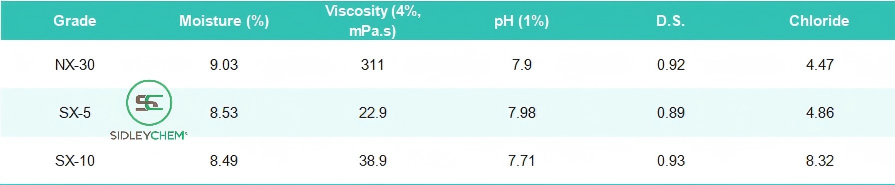
3. SIDLEYCHEM Paper Grade CMC Technical Specifications
Notes:
-
Different viscosity and purity grades can be produced according to customer requirements;
-
Granulated products require special specification.
Cellulose Ether Tech+

Why Microcrystalline Cellulose Is Widely Used in Tablet Manufacturing?
Learn why Microcrystalline Cellulose (MCC) is widely used in tablet manufacturing and how its compressibility and binding properties support direct compression… Continue reading

How Does Cellulose Ether Improve Makeup Longevity?
Makeup not lasting long enough? Cellulose ether is a natural-derived film-forming solution. How to choose between EC, HEC, and HPMC? This article breaks down their applications in lip gloss, foundation, and setting spray… Continue reading

How CMC Makes Ice Cream Creamier with Fewer Ice Crystals?
This article explains four key roles of Sodium Carboxymethyl Cellulose (CMC) in ice cream: preventing ice crystal growth, increasing viscosity, improving mouthfeel, and preventing fat separation, with SIDLEYCHEM food grade CMC solutions… Continue reading

How Polyanionic Cellulose (PAC) Improves Water-Based Drilling Fluids
Learn how Polyanionic Cellulose (PAC) improves water-based drilling fluids by controlling fluid loss, enhancing borehole stability, and optimizing drilling performance in oil and gas operations… Continue reading

Sodium Carboxymethyl Cellulose in Toothpaste
Discover why Sodium Carboxymethyl Cellulose (CMC) is widely used in toothpaste. Learn how CMC improves consistency, stability, spreadability, and overall oral care product performance… Continue reading
HEC in hand soap
Hydroxyethyl Cellulose (HEC) improves foam stability in hand soap by increasing viscosity, stabilizing foam structure, and enhancing texture, delivering a richer and longer-lasting washing experience… Continue reading

HEC for liquid detergent
Hydroxyethyl Cellulose (HEC) is widely used in liquid detergents due to its excellent thickening performance, surfactant compatibility, and stable rheology, improving product stability and user experience… Continue reading

Choosing the Right Cellulose Ether for Detergent Manufacturing
This guide provides a complete framework for selecting cellulose ethers in detergent manufacturing: comparing HEC vs. CMC performance, selection factors, and combination strategies, with SIDLEYCHEM customized product solutions… Continue reading

Oilfield Grade CMC Application
This article details the multifunctional applications of oilfield grade CMC in drilling, cementing, and fracturing fluids, including fluid loss reduction, viscosity enhancement, proppant transport, and guar gum replacement, with LVT/HVT and ultra-high viscosity specifications… Continue reading

PAC Drilling Fluid Application
This article details oilfield grade PAC applications in drilling fluid solids control, performance regulation, and system stabilization, with PAC-LV/HV specifications… Continue reading
