
Tile Adhesive Slipping After Adding HPMC: Causes & Fixes
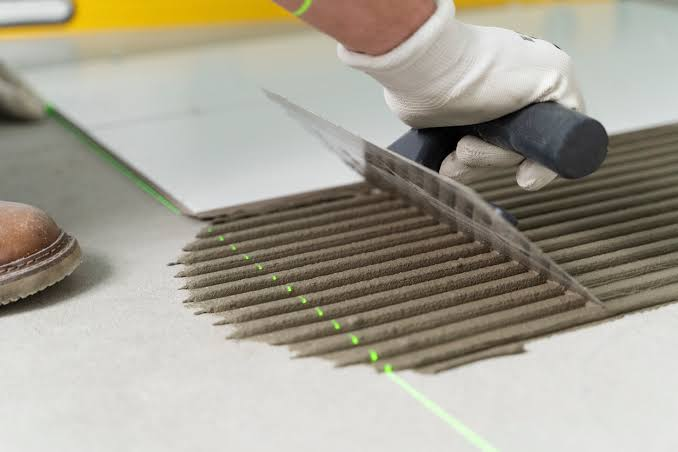
A tile adhesive shows noticeable downward movement after a tile is placed on a vertical wall.The first adjustment is often simple:“Add more HPMC.”
After increasing the dosage, the mortar becomes thicker—but the tile may still slip. In some cases, troweling becomes heavier and the adhesive becomes more difficult to spread.
Why? Because tile adhesive slip resistance is not controlled by viscosity alone. A good tile adhesive needs enough body to hold the tile after placement, but it must also spread easily under the notched trowel, wet the tile properly, and maintain sufficient open time.
If only HPMC dosage is increased, this balance may be disturbed.
1. Higher Viscosity Does Not Always Mean Better Anti-Slip Performance
HPMC/MHEC is one of the most important additives in cement-based tile adhesive.
It contributes to:
- water retention;
- thickening;
- workability;
- open time;
- wetting behavior;
- resistance to sagging and slipping.
However, anti-slip performance depends on how the mortar behaves both during movement and at rest.
When the adhesive is being mixed or troweled, it should move relatively easily.
Once the tile has been placed, the mortar needs enough structure to resist downward movement.
Simply increasing viscosity does not always create this ideal behavior.
A formulation can become very thick but still lack the rheological structure needed to hold a heavy tile securely.
2. Check the HPMC Grade, Not Only the Dosage
When tile adhesive slips, formulators often focus only on the amount of cellulose ether.
But the HPMC grade is just as important.
Different cellulose ethers can vary in:
- viscosity;
- modification level;
- water retention;
- dissolution behavior;
- influence on workability;
- interaction with cement and other additives.
Therefore, two HPMC products used at the same dosage may produce noticeably different application behavior.
The same is true when comparing two grades with similar nominal viscosity.
Instead of immediately increasing dosage, compare the current HPMC with another suitable grade while keeping the rest of the formulation unchanged.
Record:
- water demand;
- consistency;
- troweling feel;
- ridge stability;
- tile slip;
- open time.
This gives much more useful information than comparing viscosity numbers alone.
3. Too Much Water Can Reduce Slip Resistance
Water dosage is another common cause of tile slipping.
When more water is added, tile adhesive usually becomes easier to mix and spread.
However, excessive water can reduce the ability of the fresh mortar to support a tile on a vertical surface.
This creates an important troubleshooting question:
Is the HPMC dosage actually too low, or is the water demand too high?
If increasing HPMC also causes the applicator to add more water to maintain comfortable troweling, the expected improvement in anti-slip performance may become much smaller.
During laboratory testing, the water dosage should therefore be recorded carefully.
4. Starch Ether Can Improve Anti-Slip Performance
When HPMC alone cannot provide the required balance, starch ether can be an effective formulation tool.
In tile adhesive, starch ether is commonly used to improve thickening and anti-sag behavior. SidleyChem’s SE-301 and SE-302 grades, for example, are intended for tile adhesive applications, with SE-302 positioned for stronger thickening and sag resistance.
The advantage is that a small adjustment in starch ether may improve vertical stability without requiring a large increase in cellulose ether.
However, more starch ether is not always better.
Excessive dosage may make the mortar:
- too stiff;
- difficult to trowel;
- less smooth during application;
- harder to compress beneath the tile.
The dosage should therefore be optimized through application testing rather than selected only from viscosity measurements.
5. Check the Thixotropy of the Mortar
Another important factor is thixotropic agent selection.
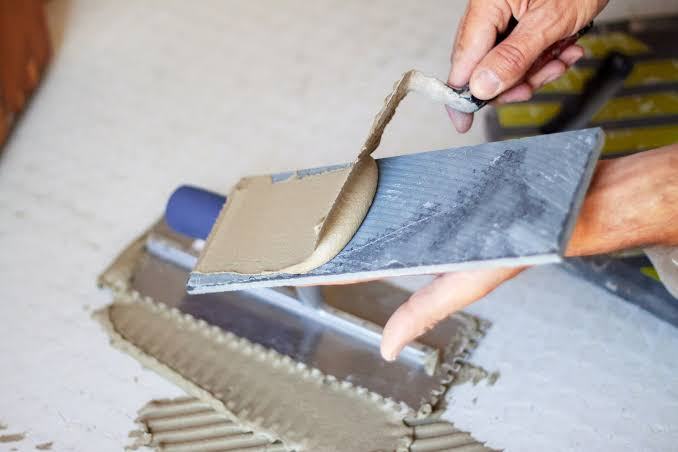
A mortar with good thixotropic behavior becomes easier to move when force is applied but rebuilds structure after the force is removed.
This is useful for tile adhesive because the material should spread under the trowel but remain stable after the tile is positioned.
SidleyChem’s thixotropic agents are designed for applications including tile adhesive and dry mortar where sag resistance and workability need to be balanced.
If the mortar feels thick during application but still allows the tile to move downward afterward, the problem may be related more to rheological structure than to absolute viscosity.
6. Tile Weight and Application Thickness Also Matter
Not every slipping problem comes from the additive package.
The application itself should also be checked.
Slip may increase when:
- large or heavy tiles are used;
- too much adhesive is applied;
- the notch size is unsuitable;
- the tile is placed before the ridges are properly formed;
- the mortar is mixed with too much water;
- the substrate is uneven.
A formulation that performs well with a small ceramic tile may not behave identically with a large-format porcelain tile.
For this reason, laboratory evaluation should reproduce the intended application as closely as possible.
The international tile adhesive testing standard ISO 13007-2 includes methods for determining slip resistance as well as open time and adhesion-related properties.
7. A Simple Troubleshooting Comparison
When tile adhesive still slips after increasing HPMC, do not change several additives at the same time.
Start with the current formulation as the reference.
| Observation | First Factor to Check |
|---|---|
| Mortar becomes thicker but tile still slips | HPMC grade and rheology |
| Higher HPMC requires more mixing water | Water demand |
| Slip improves but troweling becomes very heavy | Excessive thickening |
| Small starch ether addition greatly improves slip | Rheological balance |
| Mortar spreads easily but ridges collapse quickly | Thixotropy |
| Only large or heavy tiles show slipping | Tile weight and application thickness |
| Slip varies significantly between operators | Water dosage and mixing consistency |
8. How to Improve Tile Adhesive Slip Resistance
 Once the cause has been identified, possible adjustments include:
- optimize HPMC grade rather than only increasing dosage;
- control water addition;
- introduce or adjust starch ether;
- optimize the thixotropic system;
- check application thickness;
- reproduce the target tile size during testing;
- confirm that anti-slip improvement does not reduce open time or workability.
The final formulation should not simply be “as thick as possible.”
It should spread easily when applied, hold stable ridges after troweling, allow good tile wetting, and resist movement once the tile is positioned.
Conclusion
If tile adhesive still slips after increasing HPMC, adding even more cellulose ether may not be the best solution.
The real cause may be:
- unsuitable HPMC grade;
- excessive water demand;
- insufficient thixotropy;
- lack of starch ether;
- excessive application thickness;
- heavy tile weight;
- an unbalanced additive system.
The most effective approach is to evaluate HPMC, water dosage, starch ether, and rheology together.
For tile adhesive formulators, the target is not maximum viscosity. It is the right balance between easy troweling, stable ridges, sufficient open time, and reliable anti-slip performance.




Drymix Mortar Tech+
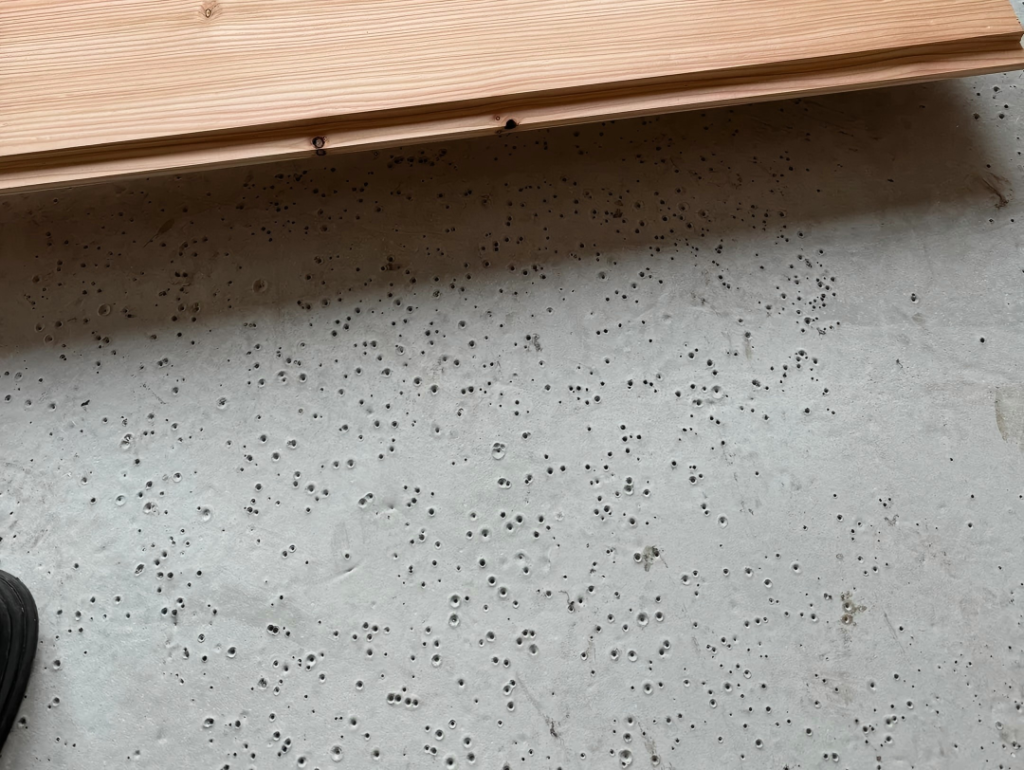
Pinholes in Self-Leveling Mortar: Defoamer, Mixing, or Substrate?
Pinholes in self-leveling mortar are not always caused by insufficient defoamer. This guide explains how to distinguish formulation foam, mixing-induced air, substrate outgassing, and insufficient healing time through a simple three-surface comparison test and practical corrective actions… Continue reading
Why Does Dry Mortar Have Poor Water Retention?
Learn why dry mortar has poor water retention and how HPMC and MHEC can improve water retention, workability, and cement hydration in dry-mix mortar… Continue reading
Dry-Mix Mortar Summer Formulation Adjustment
Why does the same formulation fail in summer? The key is cellulose ether. High temperatures cause ordinary HPMC water retention to drop sharply — increase dosage by 0.1%-0.2%, switch to high gel temperature grades, and combine with retarders. This article gives three practical adjustment directions to tackle summer construction challenges… Continue reading
Mortar Setting Too Fast in Summer Heat?
Mortar drying out in half an hour on summer job sites? High-temperature accelerated hydration is the culprit. This article breaks down the features and selection of sodium gluconate, citric acid, tartaric acid, and boric acid retarders, with dosage adjustment and blending strategies to tackle summer construction challenges… Continue reading
Why Does Dry Mix Mortar Cake During Storage?
Discover why dry mix mortar cakes during storage and transportation. Learn how moisture, packaging, raw materials, and formulation affect storage stability, and explore practical solutions to maintain product quality… Continue reading
Why Does Tile Grout Change Color After Curing?
Discover the most common causes of tile grout color inconsistency after curing and learn practical solutions through proper formulation, pigment selection, moisture control, and construction practices… Continue reading
Tile adhesive bond strength
Learn the most common reasons why tile adhesive loses bond strength and discover practical solutions through proper formulation, additive selection, substrate preparation, and construction practices… Continue reading
Gypsum Mortar Shrinkage: Causes and How to Prevent Cracks
Understand the main causes of gypsum mortar shrinkage and learn how to prevent cracks using HPMC, gypsum retarder, and proper formulation and construction practices… Continue reading
gypsum mortar water retention
Learn practical ways to enhance the water retention of gypsum mortar using HPMC, starch ether, and proper mixing techniques to improve workability and reduce cracks… Continue reading
Extend gypsum setting time
Learn why gypsum mortar loses workability too quickly and discover practical solutions using gypsum retarders, HPMC, and formulation optimization to extend working time without compromising strength… Continue reading
