Detergent Application

Cellulose ethers are widely used in various products such as detergents and personal care items.

HPMC/CMC/HEC

01Hydroxypropyl MethylCellulose (HPMC)

The Hydroxypropyl Methylcellulose D Series is a specially customised, high-purity HPMC. Selected from premium raw materials and manufactured through bespoke production processes to meet the thickening and purity requirements of the cosmetics and personal care sector, it exhibits the following characteristics:

  • High molecular weight, concentrated and uniformly substituted, delivering exceptional thickening efficiency;
  • High purity with low ash content, offering outstanding transparency;
  • Uniform surface treatment and rational particle size distribution, ensuring rapid dispersion.

Download HPMC D Series

02Sodium CarboxymethylCellulose(CMC)

Sodium CarboxymethylCellulose is the most effective active additive for synthetic detergents, primarily functioning to prevent the redeposition of soiling. Firstly, it inhibits the deposition of inorganic salts from heavy metals; secondly, it suspends and disperses soiling particles released into the aqueous solution during washing, thereby preventing their redeposition onto fabrics.

Detergent Grade CMC Catalog

03Hydroxyethyl Cellulose (HEC)

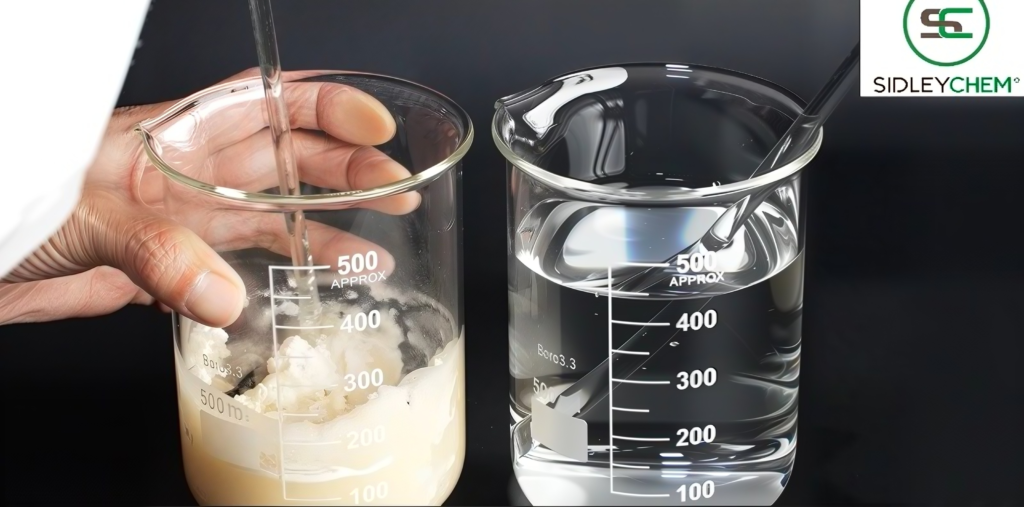
Hydroxyethyl Cellulose (HEC) is non-ionic water-soluble polymer, it is effective in thickening, bonding, emulsifying, dispersing, stabilizing and water retention, forming film and providing protective colloid effect. It is very easily soluble not only in cold water, but also in hot water, and can provide solutions with wider range of viscosity.

Download Detergent Catalog
15000CMC Annual Capacity
12000HPMC Annual Capacity
6000HEC Annual Capacity
3000HPC Annual Capacity

04Oversea Base -Get Closer to you

We are actively expanding our manufacturing footprint with new production facilities dedicated to concrete admixtures and cellulose ethers. These strategically located plants are designed to uphold the highest quality standards while bringing us closer to our customers and business partners. Our commitment is clear: to deliver consistent excellence, faster response times, and localized support.

Stay tuned for exciting updates—because at SidleyChem, our strategy is simple but powerful: get closer to our customers and grow together.

Welcome

Application of Cellulose Ether

Personal Care Formulation Process

This article lists key process points for thickeners in personal care formulations, including dissolution, pH control, salt tolerance, and selection, and introduces relevant cellulose ether products from … Continue reading

Surfactants in daily chemicals

This article analyzes the definition and amphiphilic nature of surfactants, details their roles in four major daily chemical scenarios (cleaning, skincare, oral care, cosmetics), and summarizes three core advantages. It concludes by relating to SIDLEYCHEM’s expertise and products in relevant areas such as cellulose ethers and redispersible polymer powder… Continue reading

Sodium CarboxyMethylCellulose(CMC) Applications

This article details the properties of food-grade CMC and its key applications in foods like soy milk, ice cream, noodles, and pastries, covering its thickening, stabilizing, and moisture-retaining functions with practical dosage recommendations for food formulators… Continue reading

Architectural coating system

This article details the three core functions of architectural coatings and standard coating system structures (primer, mid-coat, topcoat), analyzing the role of each layer to provide a clear technical framework for selection, formulation, and application… Continue reading

hand sanitizer formulation

A practical guide on hand sanitizer types and formulation basics. Learn about core ingredients like surfactants, HPMC thickeners, and antibacterial agents for developing effective regular, antibacterial, or waterless hand sanitizers… Continue reading

Detergent formulation ingredients

How to select raw materials for FMCG product development? This article details the functions of ten key ingredients like sulfonic acid, AES, AEO-9, and HPMC, offering crucial advice on compliance, safety, and formulation to streamline your product development… Continue reading

Fundamentals and Technical Analysis of Coatings

This article explains the three core functions of paint and provides an in-depth comparison of Vinyl Acrylic, Styrene Acrylic, and Pure Acrylic latex paints. Understanding these fundamentals helps you make informed decisions for superior coating formulations… Continue reading

Check if Your Detergent & Cleaning Products Are Qualified

Unsure if your cleaner is up to standard? This guide offers 4 simple methods: check active matter content, inspect appearance, assess viscosity, and smell for odor to quickly evaluate the quality of laundry detergents and cleaning products… Continue reading

coatings thickeners enhance application performance

How do coatings thickeners enhance application performance and coating quality? Learn about their three core functions in optimizing viscosity, improving adhesion, and enhancing hiding power, plus correct usage methods… Continue reading

Coatings Thickener Usage Guide

Complete guide to coatings thickeners: learn their key functions in viscosity adjustment, adhesion enhancement, and coverage improvement. Discover proper usage methods and important considerations for optimal results… Continue reading