
Check if Your Detergent & Cleaning Products Are Qualified
Ensuring the quality of your household cleaning and laundry products is crucial for both effectiveness and safety. Instead of relying on brand claims alone, you can perform some simple checks. This guide outlines four direct methods to evaluate the basic quality of products like laundry liquids, dish soaps, and other cleaners.
1. Check the Active Matter Content
The cleaning power of a product largely depends on its active matter (or active ingredient) content. This information is often found on the technical data sheet or product label.
Example Standards: For instance, standard laundry liquids should have a total active matter content of ≥15%, while delicate fabric washes should have ≥12%, and pretreatments for collars/cuffs ≥6%.
Why It Matters: A content lower than these benchmarks significantly reduces cleaning efficacy, meaning you’ll need to use more product for the same result.

2. Inspect the Physical Appearance
The product’s packaging and liquid appearance offer immediate clues.
Packaging: Qualitatively produced items have clean, well-molded bottles with sharp, clear, and smudge-free printing. Legitimate manufacturers will clearly state usage instructions, execution standards, net content, manufacturer address, and shelf life.
Liquid Form: The liquid itself should be uniform in color and consistency. Separation, unusual sedimentation, or suspended particles can indicate product degradation, contamination, or formulation issues.
3. Assess the Viscosity (Thickness)
While different products have different intended viscosities, drastic deviations from the norm for a similar product type can signal problems.
Too Thick: May indicate excessive use of thickeners to mask a low active content.
Too Thin/Watery: Could mean the active ingredients are insufficient, or the product has been improperly diluted.
4. Smell the Product
A qualified cleaner should have a characteristic, stable fragrance appropriate for its type.
Warning Sign: Any off-putting, sour, or rancid odor is a strong indicator that key components have begun to break down or spoil.
Conclusion
 By applying these four straightforward checks—reviewing active content, inspecting appearance, feeling viscosity, and noting odor—you can make a more informed initial judgment about the quality of your cleaning products. For manufacturers and formulators, adhering to strict quality control and using high-grade raw materials is the foundation of producing trustworthy and effective cleaners.
Cellulose Ether Tech+

CMC Paper Applications
This article details the customized applications of Sodium Carboxymethyl Cellulose (CMC) in printing paper, packaging board, tissue, and specialty paper, covering key parameters like viscosity selection and pH compatibility, with paper grade CMC specifications… Continue reading
Application Guide for Textile Grade CMC
This article details the application advantages of textile grade Sodium Carboxymethyl Cellulose (CMC) in printing pastes, yarn sizing, and dyeing auxiliaries, including rheology, water retention, stability, and eco-friendliness, with technical specifications reference… Continue reading
Cosmetic Raw Materials Classification
This article systematically categorizes 30 common cosmetic raw materials, covering oils, surfactants, active ingredients, and plant extracts, providing basic reference for formulation development and ingredient selection… Continue reading
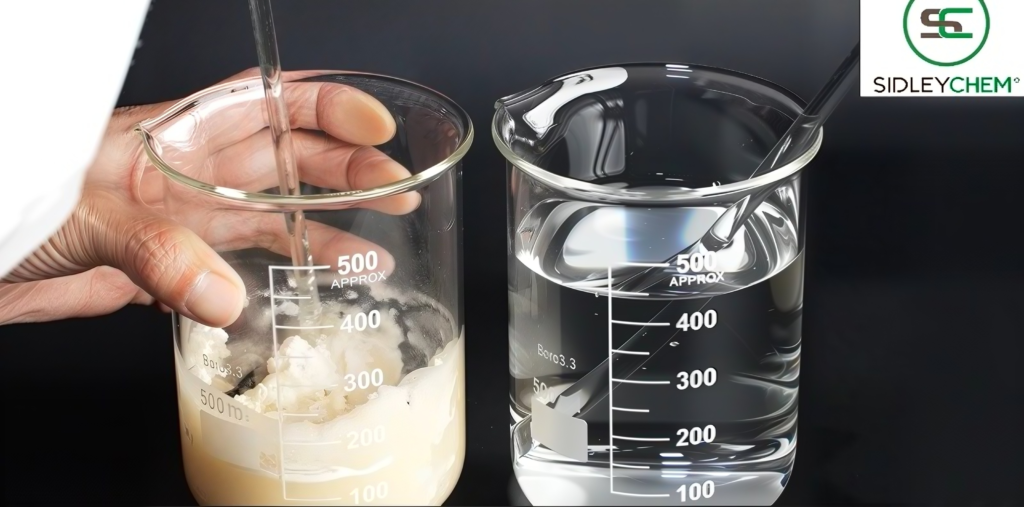
Personal Care Formulation Process
This article lists key process points for thickeners in personal care formulations, including dissolution, pH control, salt tolerance, and selection, and introduces relevant cellulose ether products from … Continue reading
Surfactants in daily chemicals
This article analyzes the definition and amphiphilic nature of surfactants, details their roles in four major daily chemical scenarios (cleaning, skincare, oral care, cosmetics), and summarizes three core advantages. It concludes by relating to SIDLEYCHEM’s expertise and products in relevant areas such as cellulose ethers and redispersible polymer powder… Continue reading

Sodium CarboxyMethylCellulose(CMC) Applications
This article details the properties of food-grade CMC and its key applications in foods like soy milk, ice cream, noodles, and pastries, covering its thickening, stabilizing, and moisture-retaining functions with practical dosage recommendations for food formulators… Continue reading

Architectural coating system
This article details the three core functions of architectural coatings and standard coating system structures (primer, mid-coat, topcoat), analyzing the role of each layer to provide a clear technical framework for selection, formulation, and application… Continue reading

hand sanitizer formulation
A practical guide on hand sanitizer types and formulation basics. Learn about core ingredients like surfactants, HPMC thickeners, and antibacterial agents for developing effective regular, antibacterial, or waterless hand sanitizers… Continue reading

Detergent formulation ingredients
How to select raw materials for FMCG product development? This article details the functions of ten key ingredients like sulfonic acid, AES, AEO-9, and HPMC, offering crucial advice on compliance, safety, and formulation to streamline your product development… Continue reading
Fundamentals and Technical Analysis of Coatings
This article explains the three core functions of paint and provides an in-depth comparison of Vinyl Acrylic, Styrene Acrylic, and Pure Acrylic latex paints. Understanding these fundamentals helps you make informed decisions for superior coating formulations… Continue reading
